The ship was two ships
Pause the intro on the opening shot: a ship adrift, far away, with more empty space ahead of her than behind. Now jump to the engine shot. Until recently, those two images showed two different ships. The first was a flat barge with two stacked decks and no visible engines. The second was a cylindrical body with two enormous exhaust bells and something like a turret. Across two consecutive cuts, an eye catches it.
The images had been produced at different times, from different descriptions, and neither started from a shared model. The fault didn’t lie with whoever generated them: the problem was that what the Santa Maria looks like from the outside was written down nowhere. It sat scattered across four documents, one piece each, and nobody had ever lined it up.
First the sheet, then the ship
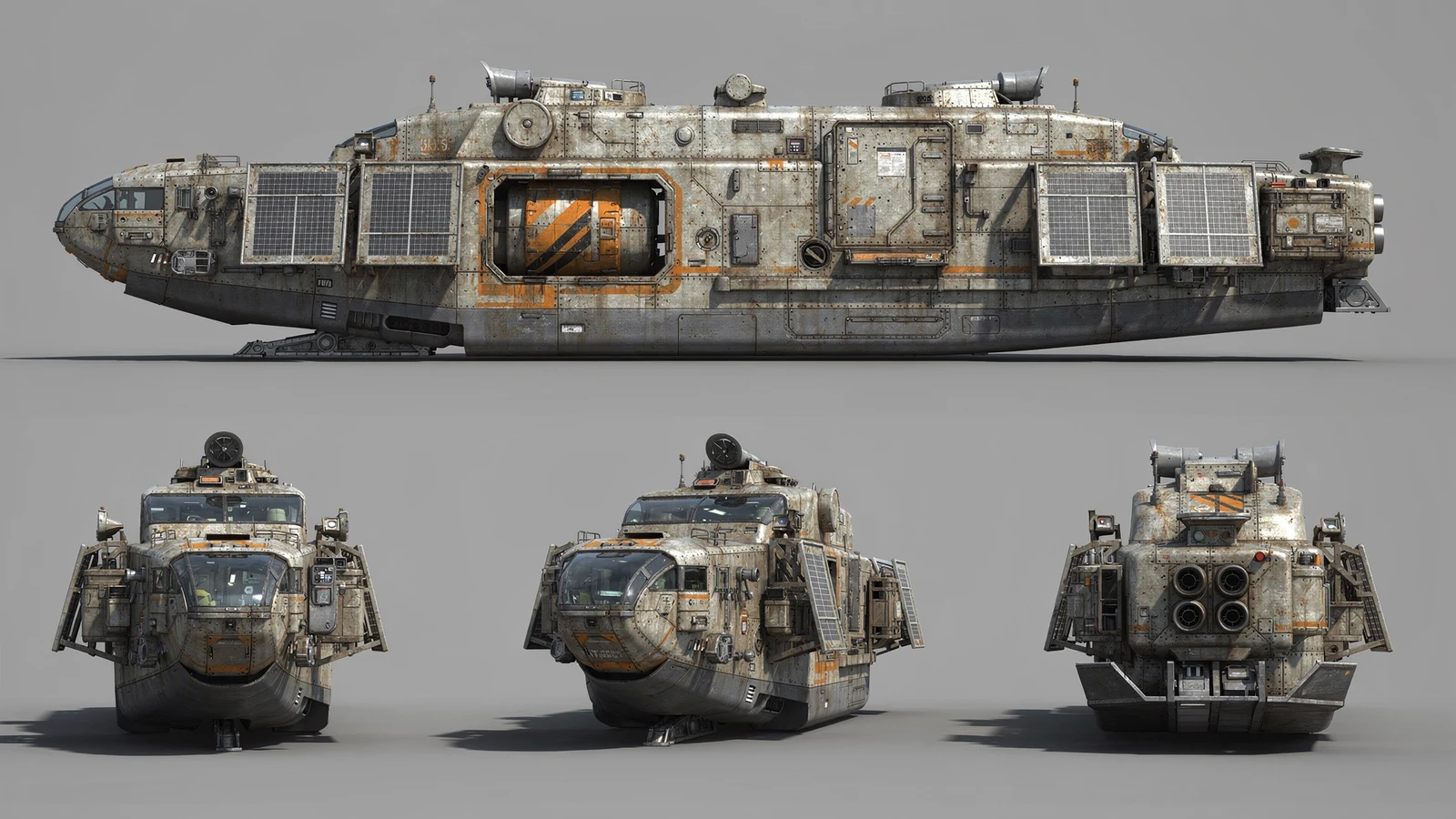
So this week we did the boring thing: we lined up the canon. Eighty metres, a cargo ship, a single occupant, ninety-nine years of registered service. The hold is the dominant volume, because on a cargo ship the cargo is the body and everything else hangs off it. The exhaust ports are flat and cold. The solar panels sit on worn brackets, and at least one has been replaced with a spare in a slightly different shade. No elegance: not one line drawn to please, because nobody ever designed this ship to be looked at.
And one small decision worth all the rest: the cargo door is on the port flank, the airlock on the starboard side. Two large openings on different flanks make the ship asymmetrical, and the asymmetry makes her verifiable. Whatever angle an image comes from, if the two openings sit on the same side the image is wrong, and you can tell at a glance.
From the sheet came a model sheet, four views of the same vessel on a neutral background, made for looking at the shape and correcting it. We threw the first attempts away: stubby lander-like ships, complete with landing gear and skids that a ship which never lands cannot have. By the third round the silhouette was right, and from there came first the canonical still and then the single reference every exterior image now passes through. None drawn from scratch, ever again.
The hull now carries her name too. TSC-1972, and SANTA MARIA beneath it, stencilled on the bow, eaten by the plate seams. On the stern plate the registry repeats, smaller, because there is a sequence where the ship will be seen from behind, and without that lettering the shot would have no identity. It sounds like a detail, but generators do whatever they like with text: in one test the registry appeared three times on the same plate, in another the letters were invented. Every image went through a one-hundred-percent check, letter by letter.
Four clips, and one is new
The three exterior shots of the intro were remade from that reference: the distant ship, the hull with the registry, the engines. Same ship, same grain, same cold light.
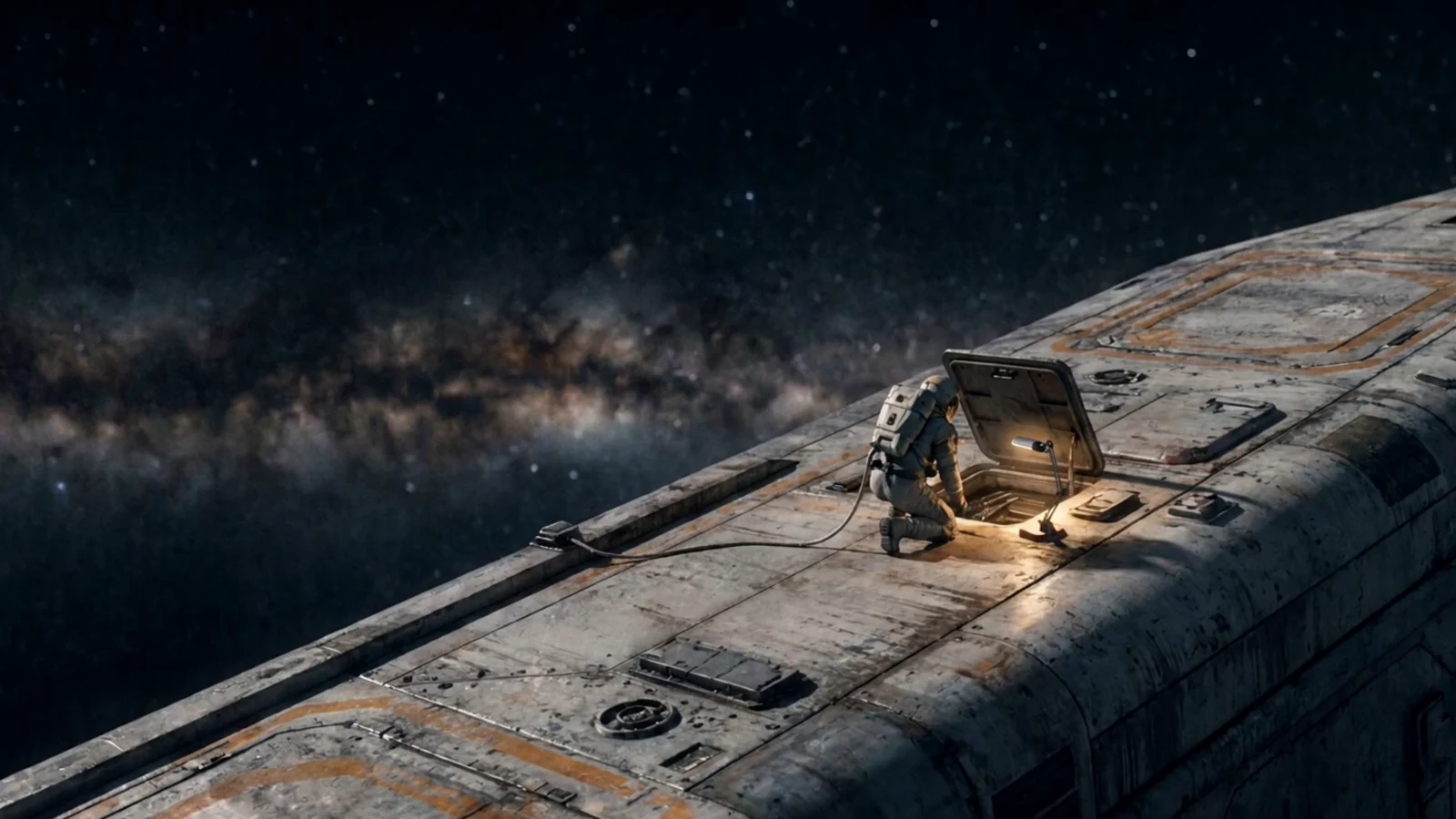
The fourth didn’t exist. The intro had an empty slot, eight seconds of black held in reserve for weeks for a shot we had never made: William outside, on the hull, working. It’s not an invention. In the game, standing at the airlock, William says: “I’ve opened it three times, always to go out and work. Never to throw anything away.” The clip shows one of those three times. A small figure in a pressure suit, kneeling at an open access panel, safety tether anchored to the hull, and the ship sliding past around him, enormous.
Here too, a mistake worth telling. In one of the generations the work light came out as a lantern resting on the ship’s spine. Simone looked at it and asked whether that made any sense. It didn’t: in vacuum, a thing that rests somewhere is a physics mistake before it’s a taste mistake. The good version has the light clamped to the edge of the panel, where anyone who has actually worked with their hands would put it.
The intro is complete
Ten shots, ten clips, one ship. We verified it whole, on the compiled build, without touching a key: William’s voice lands where it must, and the passage from the exteriors to the interiors no longer tears. The brightness jump between the engine shot and the corridor, measured on the frames, used to be fifty-three points on a scale of 255. It is now thirty-four. The two boundaries of the new clip are the softest in the whole sequence: eighteen and seven.
The opening title texts will be rearranged later, calmly. But the images they run over are done, and this chapter closes here.
The rest of the passage
Meanwhile the game went from v0.46.7 to v0.47.5, and not only for the ship.
Two lines changed thanks to the latest tester reports. One knew too much: the work suit, freshly worn, talked about the shielding of certain crates William had not found yet. One knew too little: a tester stood still with every prerequisite in hand in front of a terminal that said nothing, one click from the solution, and no line told her. The first sentence now waits for its moment; the second exists.
Then a directing decision. After the end credits there was another scene. We cut it. It leaned on a story not everyone will have read, and above all it stretched a farewell that was already complete: the game ends with the handover of the ship, and the credits are now the last thing you see. At the end of the roll, a few seconds of black, then the menu. We played it through to check, twice, and no dead end remains. Nothing was lost: that material is archived, and it may live another life, elsewhere.
And the playtests are over. Nine rounds of packages in the hands of real people, who found things we would never have seen on our own: they all stay in the end credits, each with their finding. From here to the end we work on internal builds, which don’t expire and don’t lock, because there is nobody left to protect from an old copy.
When the ship crosses the frame now, she is always the same ship.