Before it is said out loud
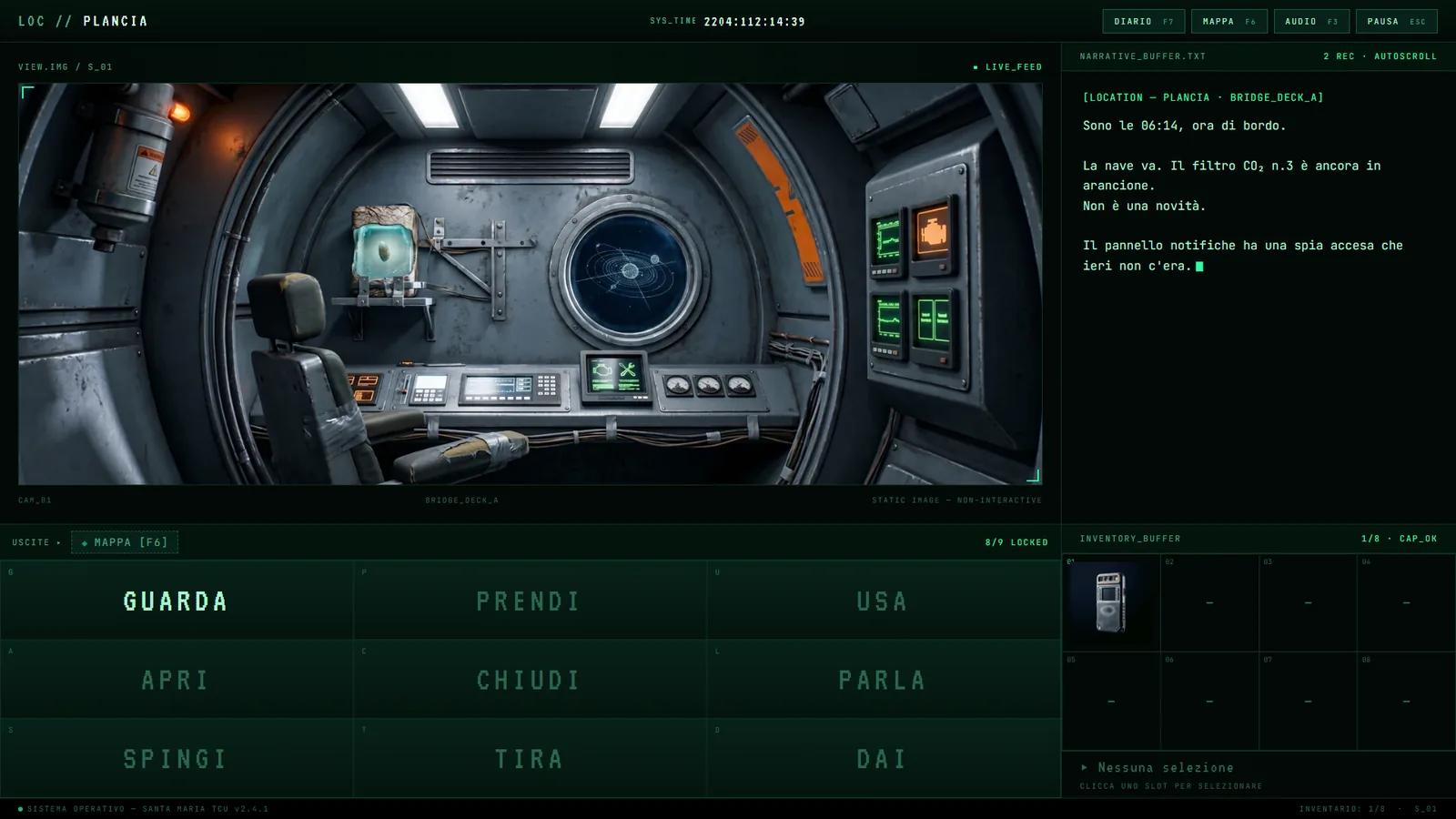
Sooner or later someone will sit down at a microphone and read the game out loud. From that moment every line has a price: changing a word stops being an edit to the text and becomes a phone call and a second session in the booth. Which is why we added nothing to the game this week. We reread what was already there.
Two hundred and forty-five lines
The code now knows which of its lines are spoken. Every line that will be recorded carries an identifier, and from those identifiers the list of everything needing a voice builds itself. Right now it comes to two hundred and forty-five.
The real shift is elsewhere. The recording script is no longer written. It is generated. There used to be a document with the lines in it, and a game with the lines in it, and the two copies were free to drift apart in silence every time somebody fixed a comma on one side only. Now the text lives in one place, the game, and the document holds what the game cannot know: what tone a line wants, where it should slow down, where the pause falls, which word takes the stress. The script that reaches the booth comes from joining the two, freshly each time, and it cannot describe a line that no longer exists.
The words the game kept repeating
Then there is the revision proper, which runs in lots: two files at a time, usually two rooms, sometimes a character’s dialogue tree. A table approved line by line, applied to the letter. Six are done. In the last three alone, close to three hundred lines changed.
The most widespread fault was a bad habit in the interface. Try something the game would not allow, and the answer came back as a flat refusal. “It won’t open.” And next time: “It won’t open.” Eight times in the same room. Then “No response.” seven times, “It won’t close.” another seven, “It won’t move.” five. On one object alone, the same answer came up six times in a row. In the engine room, two seconds apart and in two different places, the game said the same thing twice about the noise of the engines.
In the worst lots, more than sixty per cent of the answers opened with a no. Those formulas no longer appear as a whole answer, because the rule changed: an answer says what the thing is, instead of listing what cannot be done with it. “It won’t open.” became “It’s a bunk.” Same cost to read, and it gives something back.
Three mistakes that had been in front of us for months
Reading at that level of attention turned up errors none of the earlier passes had caught. The ship’s corridor was fifteen metres long on one screen and fourteen on three others. A piece of equipment went by a name that does not exist in Italian. And for months a description mentioned two crates in a room whose artwork has always shown four, with a comment in the code certifying the error instead of fixing it.
None of the three breaks the game. All three would have been spotted by an attentive player, and the second one would have been read aloud by an actor who knows what the tools are actually called.
A room showing the wrong version of itself
The worst thing we found this week was not text at all. One of the rooms has two illustrations, a before and an after, and it swaps when a certain thing happens in there. Except the condition had been written in a way that made it always true, so the room always showed the after. Including the first time you walked in.
The “before” artwork had been sitting in the repository since May, paid for and never seen by anyone, version after version for two and a half months. Anyone playing in that period walked into the room and found it already turned over, before having any reason to think there was something to turn over.
Seven small programs that read the game for us
The last part of the week is the least tellable, and the one that will serve us most. Seven small programs compare the documents against the code and stop when the two disagree. One counts and measures. One checks that every line in the game is covered by the table. One checks that the replacements we mean to make actually exist, and in how many copies. One tries a lot out on a copy of the game before the original is touched. One keeps the tally of spoken lines. One hunts for lines the documents quote and the game no longer contains.
The seventh justifies the other six. It checks the stage directions: when a note tells the actor to lean on a particular word, it goes and looks for that word in the line. Out of forty-five checkable notes it found four pointing at words that had gone, all four on text rewritten that same morning. An older one asked for weight on a year, 2187, which we cut from the game last week after a tester told us there were too many dates in it.
In the booth those notes would have ended up with somebody reading off a sheet and trusting it. They would have hunted for a word that is not there, or hit a date the game no longer says, and nobody would have noticed until the edit.
Meanwhile
Nobody playing will ever notice this week. There is nothing new to look at. Nothing new to do either. There is a game that says the same things in better words, and an archive that now checks itself before sending anyone in to read aloud. Of thirteen lots, six remain: the next one is the ship’s archive, and it has already been measured.