What you can see
Of Mario Trani’s letter — our first outside tester — last time we only told you the opening line: the game showed up off-centre, he could see a quarter of it. Fixed in two lines of code. The rest of the letter said less comfortable things, and it kept us busy for days.
A shelf that read as furniture
Mario was stuck. He had the ratchet, the sensor, the suit, and no idea what to do next. Reconstructing his playthrough, it turned out he was missing exactly one object: the backup drive, which sits on a shelf in the cabin. He had been through that room. He had even picked up the suit two steps away. The shelf he had read as furniture.
You learn more from one block like that than from ten successful playthroughs. Three corrections came out of it.
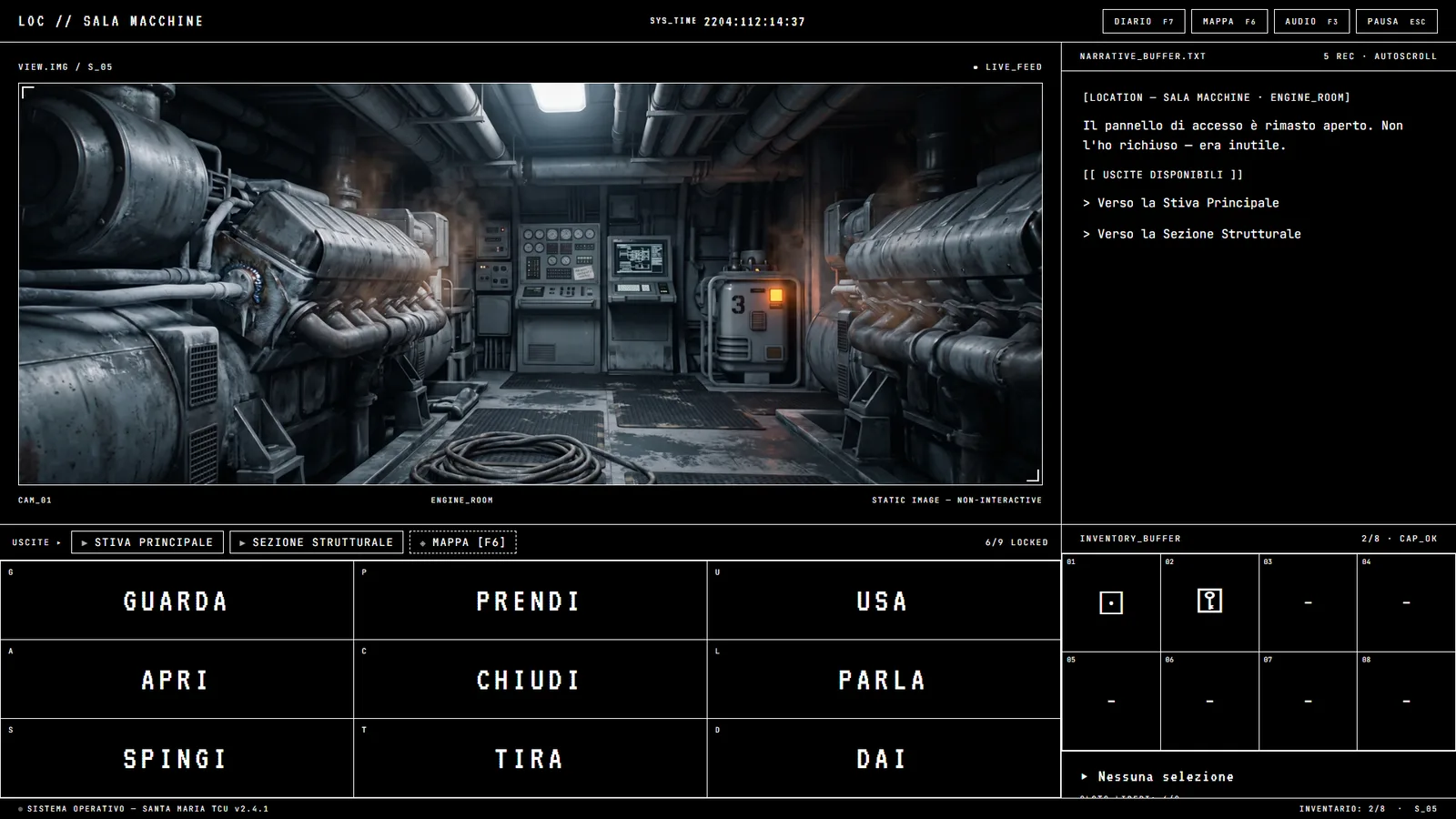
The exits from a room had become a line of small, dim links sitting among the other commands. Now they have a bar of their own at the top of the panel, with the destination names and the map button beside them. The map already existed, with its own key and a button at the top of the screen, and Mario never opened it: clearly, up there among the telemetry, is not a place anyone looks.
The second time you walk into the engine room without the drive, William now says out loud where to look. It isn’t a friendly hint firing at random: it’s a precise condition, written into the content, that triggers only for someone already stuck.
And the word “inventory” has left William’s mouth. He used it in three places, and in those three places the captain of a 2204 cargo ship talked like an instruction manual. Windows and menus are ours, the terminal’s; he talks about pockets and crates.
The size of the type
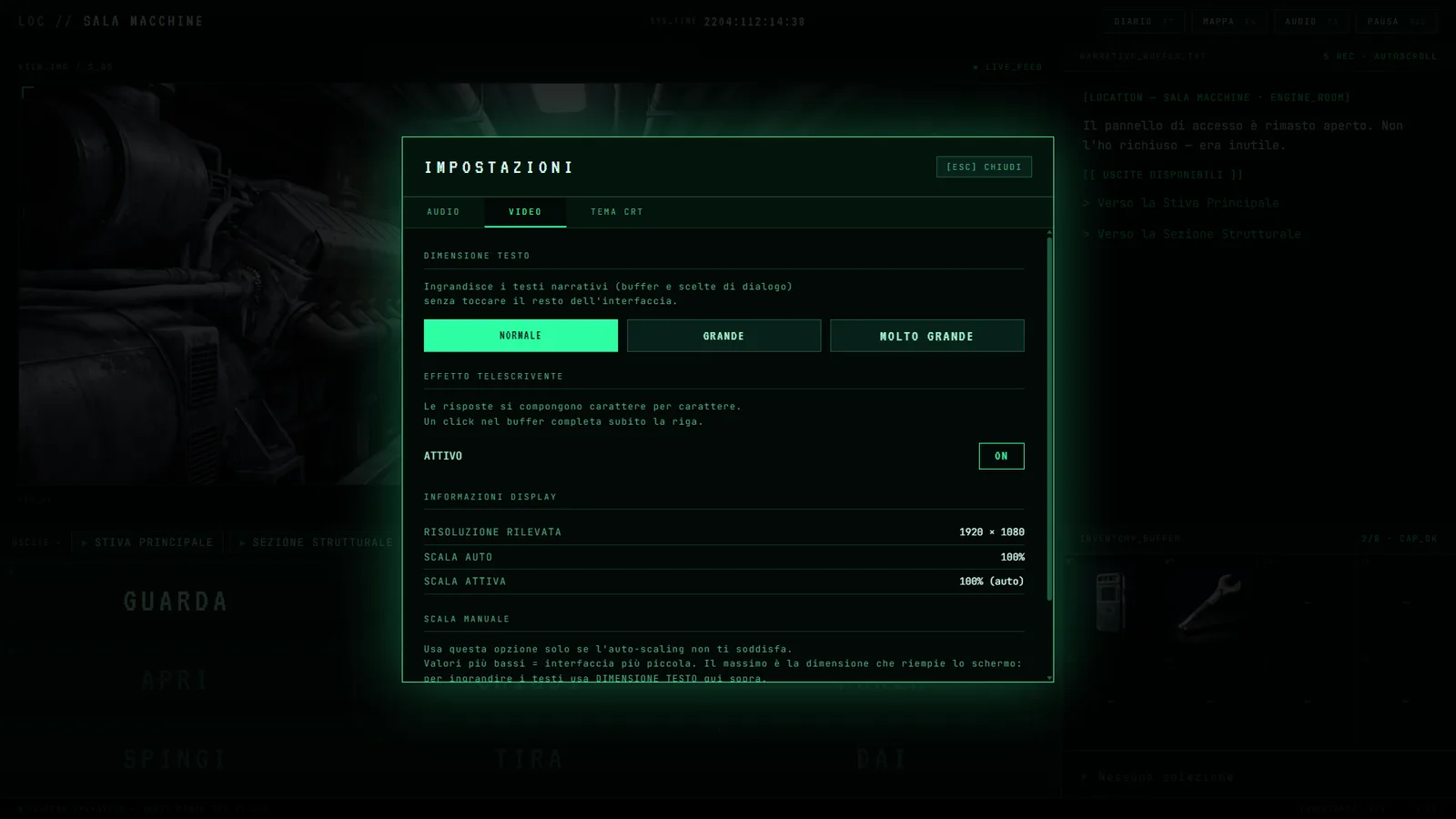
“The characters far, far, far too small,” Mario wrote. Three times too. And he added that enlarging things from the settings left the text identical, with the added insult that the images went off the screen.
He was right twice over. The scaling we had was a magnifier over the whole interface: it enlarges everything together, so the ratio between the text and everything else never changes, and past a certain point the game frame grows wider than the monitor and spills over. A magnifier that also enlarges the edge of the table is no help in reading.
Now there is TEXT SIZE, in three steps: normal, large, very large. It touches only the two areas that scroll — the narrative buffer and the dialogue choices — and doesn’t move the verb grid, the inventory or the image by a single pixel. The text grows and scrolls further; the interface stays put. Manual scaling is still there for anyone who wants it, but it now has a ceiling: it can no longer exceed the size that fills the screen, whatever value yesterday’s settings might still hold.
The same tab gained a teletype effect: replies compose themselves character by character, at roughly a hundred and thirty a second, and a click completes the line at once for anyone not in the mood to wait. It’s on by default and off with a switch. It isn’t a decorative tic: it gives the text time to arrive, and the reader time to find it.
Four screens, and a fifth way
The Santa Maria’s terminal can change colour, and it has been able to from the start. Four palettes: cold, the default sea green; warm, the yellowish green of the Apple //e; amber, with an orange accent on the data; and paper, white monochrome phosphor, which is the easiest of them all on the eye. You switch while playing and the change is immediate.
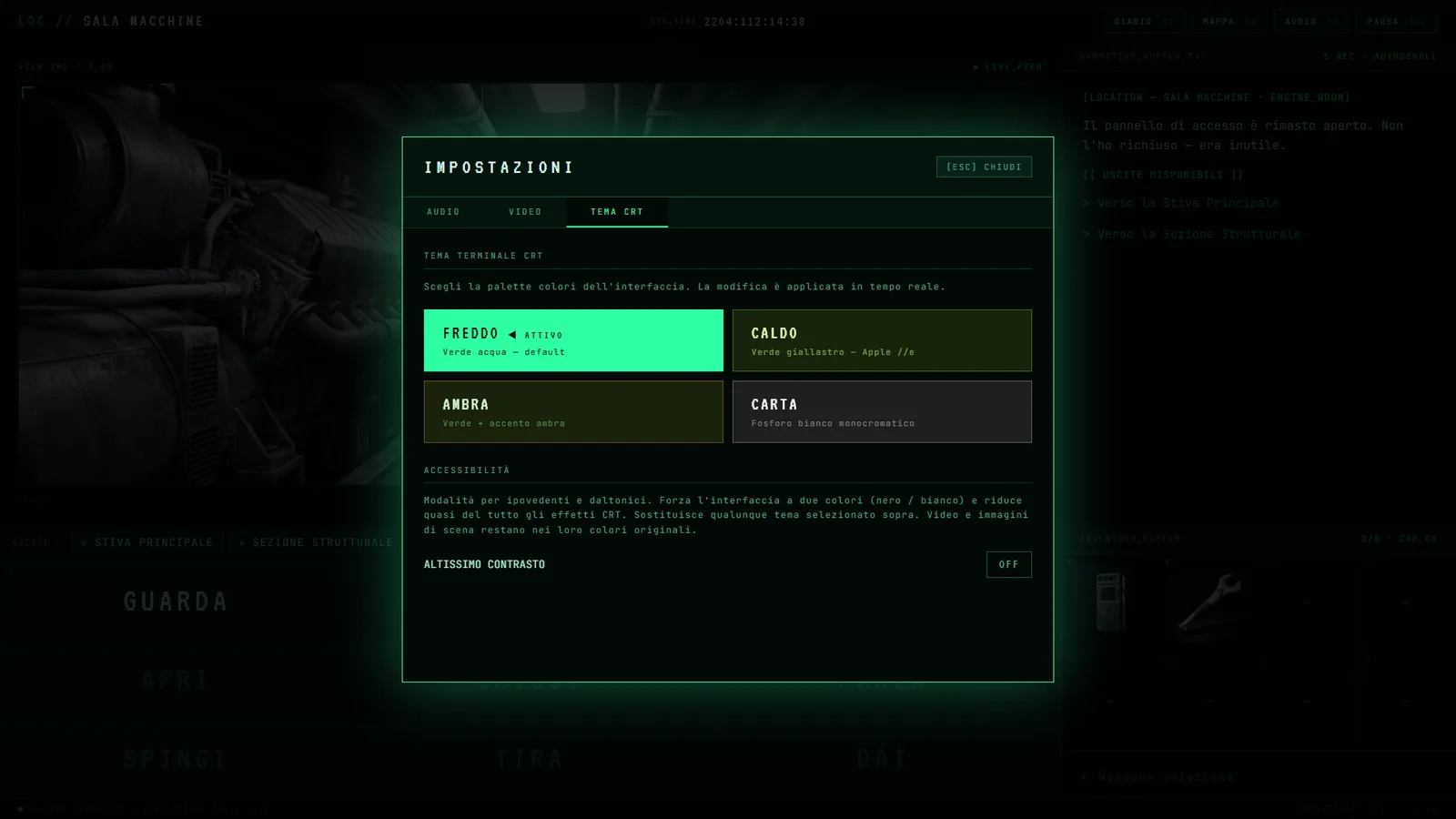
Below the palettes sits an option that isn’t a palette: very high contrast. Designed from the outset for players with impaired sight or colour perception, it takes the interface down to two colours, white on black, and switches off nearly all of the cathode-ray fiction — no scanlines, no green bloom, no flicker. It overrides any theme, and while it’s on the palette choice sits there greyed out, a reminder that something else is in charge.
And here is the thing that makes this devlog as useful to us as it is to you. While preparing the screenshot below we turned the mode on and photographed the game: where the engine room should have been there was an empty rectangle with the name of the room in it. The scene images disappeared. They always had, and the settings screen has always claimed the opposite, in writing: “Video and scene images keep their original colours.”
Nobody had noticed because none of us plays in that mode. Anyone who needs it, though, would have been left with half a game — taken away in exchange for being able to read it. The rule now is the one the text promised: the interface and the writing change, the ship stays the ship.
Fewer dates
Another of Mario’s notes, minor only in appearance: too many years. Every object you looked at answered with its date of manufacture, and after enough numbers the world turned into a spec sheet.
Twenty-five four-digit years surveyed, fourteen lines rewritten. The suit no longer carries a certified overhaul from 2191: it’s two renewals past due. The bridge chair wasn’t bought “somewhere between 2185 and 2187, probably”, but in the years of the long hauls — the vagueness was the point, and the date contradicted it. The engines are first generation. The load-bearing structures come from when things were built to outlast their builders.
The dates that carry plot are still standing: the ones that come back in dialogue and documents, and that wouldn’t work without the number.
The titles, again
Last week we wrote that the main titles were settled. Seen on a real screen, they weren’t: imperfections frame by frame, a bloom that spread too far, letters lighting up in order like a web animation with a filter over it.
They were rebuilt from scratch, looking at how cinema does it. The letters fade in one at a time while the spacing widens slightly, and the film’s name assembles itself out of half-letters arriving in no particular order — that’s the treatment of the Alien titles, and there is no reason to look for a better one. Eight blocks, one per clip, all of them in English.
The voices are on hold
Away from the code, the week brought the first recordings from Leonardo Tomassetti, William’s voice. Six long files, from which we extracted thirty-eight separate lines: the machine transcribes the speech, aligns it to the script word by word and cuts at the right points without re-compressing the audio. It worked, which is exactly the trial run we wanted.
And that is why voice work now stops. Every line of text we touch — and we touched fourteen this week for the dates alone — is a line already recorded that would have to be recorded again. You record when the script is closed, not before. The voices are waiting for the game to stop changing its mind.
Meanwhile
The sixth tester build has been packaged and verified — this time at four different resolutions, not just ours — and it’s out there. Thank you, Mario: half of this devlog is yours.